Agenk is the partner of choice for many of the world’s leading enterprises. We help businesses development.

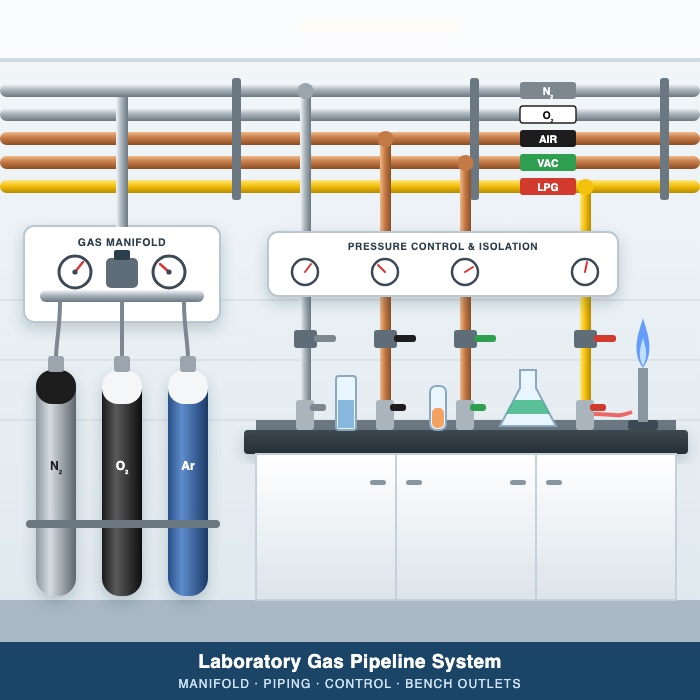


Pragati Pipe Gas is leading Laboratory Gas Pipeline Installation Services in Pune. Laboratory gas pipeline installation provides a structured distribution system for supplying required gases to laboratory workstations, instruments, testing areas, research facilities, and other designated points. A properly planned system can connect centralized gas sources with multiple laboratory outlets while keeping the distribution network organized and accessible.
Laboratories may require different gases depending on their research, testing, analytical, medical, pharmaceutical, educational, or industrial applications. These can include oxygen, nitrogen, hydrogen, argon, helium, carbon dioxide, compressed air, vacuum, and other specified services.
We provide laboratory gas pipeline solutions based on the facility layout, gas requirements, equipment locations, source arrangement, and project specifications. The scope can include pipeline planning, installation, manifolds, control systems, outlets, valves, testing, commissioning, and system modifications.
A Laboratory Gas Pipeline is a dedicated network designed to distribute required gases from a source or manifold to selected laboratory points. It can be planned for a single laboratory or a larger facility with multiple rooms and departments.
A Laboratory Gas Pipeline System may include:
The system configuration depends on the types of gases required, number of outlets, laboratory layout, equipment requirements, and operating conditions.
Laboratory Gas Pipeline Installation Services in Pune begins with understanding the facility and identifying the areas that require gas services. Pipeline routes are then planned to connect the gas source with the required workstations and equipment points.
The installation process may include:
The final arrangement should be developed according to the actual laboratory requirements rather than using a standard configuration for every facility.
Laboratory Gas Pipeline Installation Services in Pune can cover different stages of a laboratory gas project, from initial planning through installation and ongoing support.
The service scope may include:
A Laboratory Gas Pipeline Contractor can coordinate these activities according to the facility layout and project requirements.
A Laboratory Gas Pipeline Company can support laboratories requiring centralized gas distribution for research, testing, analytical, production-support, or educational applications.
Projects can range from a small laboratory with a limited number of gas outlets to larger facilities with multiple rooms, floors, and gas services. The pipeline arrangement should therefore be planned according to the laboratory's actual usage and infrastructure.
Different laboratory processes require different gases. Each gas service should have a suitable distribution arrangement based on its intended application.
Laboratory Compressed Air Pipeline provides a distribution network for compressed air to selected laboratory equipment and workstations. The system can be planned according to the number of required connection points and the equipment arrangement.
A Laboratory Vacuum Pipeline System provides centralized vacuum distribution to designated areas. It can connect a vacuum source with multiple laboratory points through a planned pipeline network.
A Laboratory Nitrous Oxide Pipeline may also be installed for facilities where nitrous oxide is specifically required for an approved laboratory or related application.
Gas pipeline systems can be designed for many types of laboratory environments. Each facility can have different gas requirements depending on its research, testing, equipment, and operational activities.
Applications include:
The pipeline configuration should be based on the laboratory's equipment, workstations, gas consumption, room layout, and designated service points.
Educational institutions may require gas distribution systems for practical training, demonstrations, research, and laboratory experiments.
Gas Pipeline Installation for Educational Laboratories can be planned around laboratory benches, equipment positions, gas sources, and required outlet locations.
The same approach can be applied to Gas Pipeline Installation for University Laboratories and Gas Pipeline Installation for College Laboratories, with the system configuration determined by the educational facility's requirements.
Research and testing facilities may contain multiple laboratories with different gas requirements. A centralized distribution network can help organize the supply of required gases to designated departments and workstations.
A Laboratory Gas Pipeline for Research Centres can be developed according to the facility layout, number of laboratories, gas types, and equipment requirements.
Similarly, a Laboratory Gas Pipeline for Testing Centres can support designated analytical, testing, and instrument areas.
Specific gas pipelines can be planned according to the intended application and laboratory equipment.
Laboratory Gas Manifold Installation connects gas sources such as cylinders or other supply arrangements with the laboratory distribution network.
A manifold can be configured according to the gas service, number of sources, required connections, and project requirements. Proper planning can also help provide an organized transition between the source and distribution pipeline.
A Laboratory Gas Control Panel can be used as part of a centralized monitoring or control arrangement, depending on the project design.
A Laboratory Gas Pressure Control System can regulate or manage gas pressure according to the requirements of the downstream distribution network and connected equipment.
Pressure control requirements vary between gases and applications, so the arrangement should be selected based on the specific system design.
A Laboratory Gas Alarm System can provide an indication when a monitored condition requires attention. The alarm arrangement may be connected to selected monitoring points or control equipment according to the project design.
A Laboratory Gas Valve System provides isolation and control arrangements for selected sections of the distribution network. Valves should be positioned to remain accessible for authorized personnel and maintenance activities.
A Laboratory Gas Outlet System provides designated connection points for laboratory equipment, instruments, and workstations.
Laboratory Gas Terminal Units can be installed at suitable locations according to the laboratory bench layout, equipment arrangement, and required services.
The outlet type and connection arrangement should be selected according to the gas service and intended equipment application.
Testing and commissioning are important stages of a laboratory gas pipeline project. After installation, the system should be inspected and tested using appropriate procedures before being placed into operation.
Testing may include:
Maintenance requirements can vary according to the pipeline configuration, operating conditions, gas types, and laboratory usage. Regular inspection can help identify components requiring servicing or replacement.
Laboratory gas systems require careful planning because different rooms, instruments, and processes may require different gases and operating conditions. We focus on developing solutions around the actual laboratory layout and project requirements.
Our scope can include:
Each project can be assessed individually to establish a practical and organized gas distribution network.
Choose Pragati Pipe Gas is leading Laboratory Gas Pipeline Installation Services in Pune. Laboratory gas pipeline installation provides a centralized method of distributing required gases to laboratory workstations, instruments, research areas, and testing facilities. A properly planned network can support laboratories across pharmaceutical, chemical, medical, industrial, scientific, educational, and research environments. Proper planning of pipelines, manifolds, pressure controls, valves, alarms, outlets, and terminal units helps establish an organized laboratory gas infrastructure. Testing and commissioning should also be completed using suitable procedures before the system is placed into operation.
A laboratory gas pipeline is a distribution network that transfers required gases from a centralized source or manifold to designated laboratory workstations, equipment, and outlets.
Depending on the application, laboratories may require oxygen, nitrogen, hydrogen, argon, helium, carbon dioxide, compressed air, vacuum, nitrous oxide, and other specified gases.
They can be used in research laboratories, pharmaceutical facilities, chemical laboratories, testing centres, medical laboratories, pathology laboratories, industrial laboratories, universities, colleges, and other scientific facilities.
A gas manifold connects the gas source arrangement with the distribution pipeline and can provide an organized supply connection for one or more gas sources.
Yes. Appropriate inspection and testing should be completed after installation to verify the pipeline, connections, valves, outlets, controls, and other system components before commissioning.